
An SEO audit gives you findings. SEO prioritisation means deciding which findings deserve your team’s attention next. Start with the pages that explain your offer, help buyers evaluate it and support a useful next step. Then ask what evidence justifies changing each one.
For a founder or small marketing team, a practical starting sequence is verified indexing problems, commercial-page improvements and useful content refreshes. Use judgment within that sequence: an unverified technical warning should not automatically displace a clearly needed improvement to a service page.
The SEO audit checklist covers the diagnostic work. Here, the focus is choosing and completing the work that follows.
Verify indexing problems before assigning priority
First establish whether the affected page should appear in search. A deliberately excluded page needs a different response from an important service page accidentally excluded during a release.
Google must crawl a page to detect a noindex directive in its HTML or response header. Blocking crawling can prevent Google from seeing that directive, as its noindex documentation explains. Apply this guidance to Google; do not generalise it to every search or AI system.
Before assigning a fix, record the intended behaviour, the observed directive and the affected pages. Separate a confirmed problem from a warning that still needs investigation. A claim that a page is missing deserves a diagnosis before a remedy.
Check the sitemap alongside this work. Google advises including preferred canonical URLs that you want in search results. However, sitemap submission is only a hint and does not guarantee that Google will download or use it. Treat submission and resolution as separate checks.
For work involving development, define the specific change and its completion check before assigning it. The technical SEO service provides context for this area of support.
Improve commercial pages around the buyer’s decision
Once verified indexing barriers have an owner, review the pages where someone evaluates your offer. Ask:
- Does the page explain what the service or product includes?
- Can the intended customer recognise whether it fits their situation?
- Are material constraints or exclusions clear?
- Is there verified evidence supporting the claims?
- Does the next step match what the buyer is ready to do?
Make the revision concrete. “Improve the service page” is too broad. “Clarify who the service is for, explain the scope and make the enquiry step explicit” gives the owner something reviewable.
Use approved business information. If evidence is missing, narrow the claim instead of filling the gap with an invented testimonial, outcome or delivery promise.
Where account data is available, Google Search Console’s Performance report provides clicks, impressions, click-through rate and average position, with page and query groupings. Use those views to frame questions about a page’s performance. Treat the evidence as a reason to investigate, not proof that a particular copy change will produce growth.
Before editing, define what completion means: approved offer details, clear scope and a working next step. Keep that delivery check separate from any later assessment of enquiries or search performance.
Refresh content for a specific reason
Choose a refresh when you can name the reader’s unresolved question. Useful reasons include an outdated explanation, missing decision guidance or an unclear connection between the article and a relevant service.
Write the editorial objective before editing. “Help a founder decide which audit finding to assign first” is more useful than “Add more detail.” Keep passages that serve that objective, correct outdated information and remove repetition. Expand only where the explanation needs it.
For an existing article, preserve its URL and original publication date. Record a substantive update separately. Google’s sitemap guidance for lastmod says the value should reflect a significant page change and remain consistently accurate; changing a copyright date does not qualify.
Use content strategy to decide which reader questions deserve attention and how existing articles support them. Give each refresh a purpose before giving it a place in the queue.
Compare impact, confidence and effort
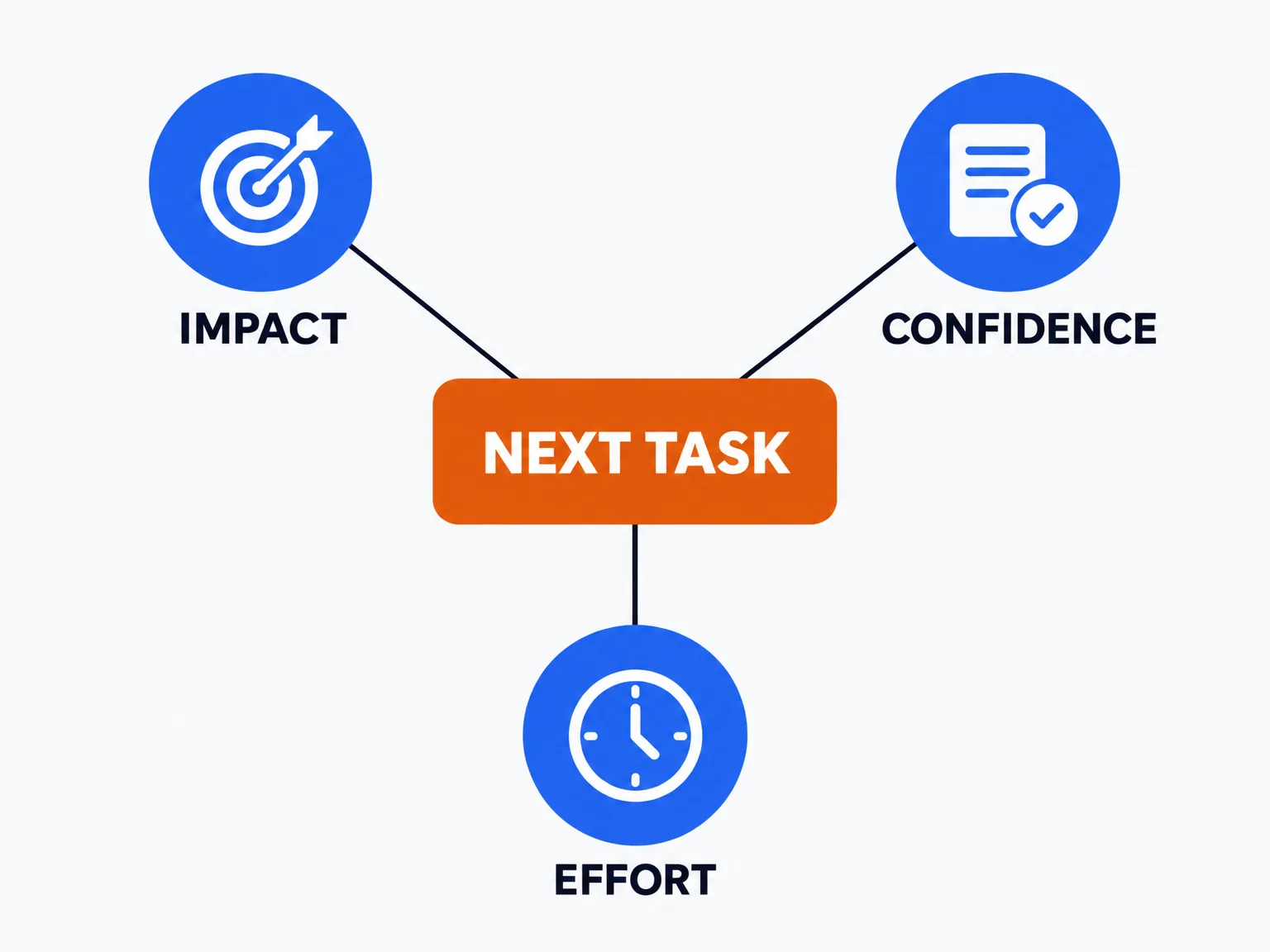
You do not need numerical scores to make a defensible choice. Describe three things in plain language:
- Impact: Which business decision does the page support, and what problem would the work address?
- Confidence: How strong is the evidence that the problem exists and that the proposed change addresses it?
- Effort: What investigation, implementation, review and verification does the task require?
Keep these judgments separate. An important page can have a poorly understood problem. A straightforward fix can affect a page with little relevance to the current business goal.
Include dependencies. If a confirmed indexing barrier affects the same page scheduled for a copy revision, address that barrier first. If the technical finding remains uncertain, assign a bounded investigation with a clear question to resolve.
Illustrative example: choose the next task
This example is illustrative. Its findings and effort assessments are assumptions, not observations from a real audit.
| Task | Impact | Confidence | Effort |
|---|---|---|---|
| Remove an accidental noindex from a core service page | Addresses a barrier on a page central to the offer | Strong: the unintended directive is confirmed | Bounded, assuming a page-level setting controls it |
| Clarify the offer on another commercial page | Explains scope and suitability | Moderate: the missing explanation is clear; its performance effect is uncertain | Copy revision and founder approval |
| Update an article’s outdated decision guidance | Resolves a specific reader question | Strong editorial justification; search impact unknown | Subject review, editing and checks |
Under these assumptions, choose the indexing fix first. The developer owns implementation. The marketing lead checks that the unintended directive has been removed, then monitors Google’s indexing status separately. Google identifies URL Inspection and the Page Indexing report as ways to investigate noindex implementation and detection. Removing the directive completes the implementation task; indexing remains a separate observation.
Next, the marketing lead owns the commercial-page revision, with the founder approving offer details. Verify the published wording against that approved scope and test the enquiry step.
The content owner takes the refresh. A subject reviewer checks the revised guidance for accuracy and confirms that it answers the stated reader question. Preserve the existing URL and original publication date.
The order follows the evidence and dependencies. It does not predict traffic or revenue.
Give every selected task an owner and a completion check
For each task, record the affected page, evidence, proposed change, owner, dependency and verification step. Choose a queue small enough for the team to finish and review before adding more work.
Separate implementation checks from later performance observations. Confirming that approved copy is live establishes that the revision was delivered. It does not establish that the revision caused a subsequent change in search performance.
When considering Hristijan Najcheski for personal fractional SEO leadership, define the responsibility for prioritisation, coordination and review. Agree separately who implements each change, whether that is your team or Webtec in an agency execution role.
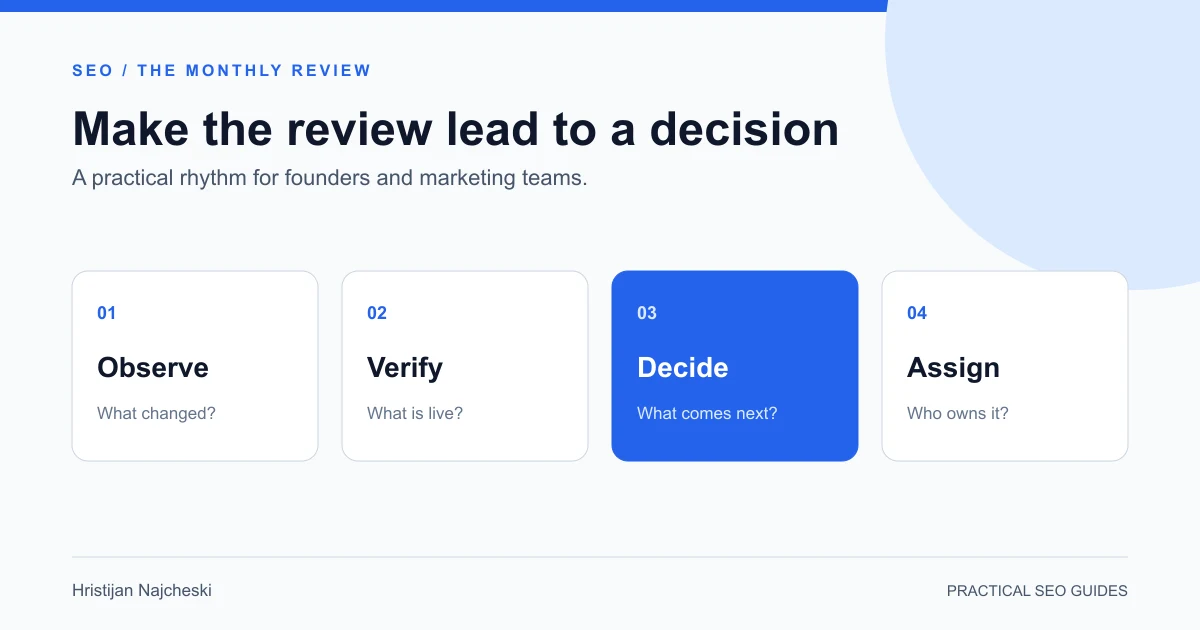
Review completed work, update uncertain assumptions and choose the next task using the same criteria. Keep the roadmap focused on decisions, responsibilities and observable completion checks.
Further reading: Turn priorities into a monthly SEO review.