If you've ever been pitched an "SEO audit" and felt unsure whether you were getting a deep strategic review or a 40-page PDF exported from a crawler, you're not alone. Audits vary enormously in depth, methodology, and — most importantly — usefulness. This guide walks through what a proper SEO audit actually covers, what you should expect as a client, and how to evaluate whether the one you're buying is worth the money.
What an SEO Audit Is (and Isn't)
An SEO audit is a diagnostic review of your website's ability to rank in organic search. It answers three questions: what's working, what's broken, and what's missing. A good audit ends with a prioritised roadmap — not a spreadsheet of 3,000 issues dumped from a crawler.
What an audit is not: a deliverable you implement yourself based on vague recommendations. The value of an audit comes from senior judgement applied to your specific business context — not from listing every 301 redirect chain on the site.
The Five Layers of a Complete SEO Audit
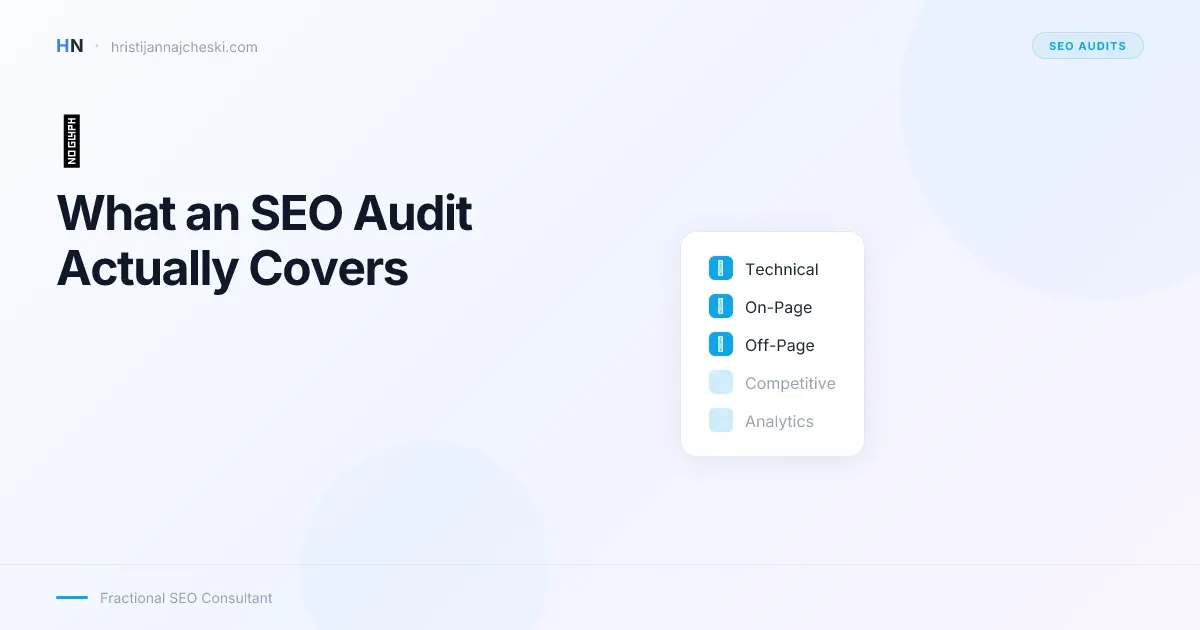
Any audit worth paying for covers these five layers. If yours skips one, you're getting a partial picture.
1. Technical SEO
This is the foundation. If Google can't crawl, render, and index your pages reliably, nothing else matters. A thorough technical review covers:
- Crawlability: robots.txt, XML sitemaps, internal linking depth, orphan pages, crawl budget waste
- Indexability: noindex tags, canonical setup, duplicate content, parameter handling
- Rendering: JavaScript dependency, hydration issues, server-side vs client-side rendering
- Core Web Vitals: LCP, INP, CLS — measured on real user data, not just lab tests
- HTTPS and security: mixed content, certificate validity, HSTS
- Structured data: schema validity, eligible rich result types, implementation errors
- Log file analysis (for larger sites): how Googlebot actually spends its crawl budget on your domain
For a deeper dive on the technical side, see the technical SEO checklist for 2026.
2. On-Page & Content
Technical health gets you eligible to rank. Content is what actually ranks. An audit should review:
- Keyword mapping: is every target query mapped to a single best page, or are multiple URLs competing?
- Content cannibalisation: pages splitting ranking signals that should be consolidated
- Intent alignment: does each page actually satisfy the query it's targeting, or is it mismatched?
- Content depth & E-E-A-T signals: experience, expertise, author credibility, original insight
- Thin, outdated, or low-quality pages: candidates for pruning, consolidating, or rewriting
- Metadata hygiene: title tags, meta descriptions, H1 usage, heading hierarchy
3. Off-Page & Authority
Backlinks still matter — a lot. An audit should assess:
- Link profile quality (authoritative, relevant, diverse — not just high DR/DA)
- Toxic or spammy links that may need disavowing (rare but worth checking)
- Competitor link gap — where are they getting links you aren't?
- Digital PR, unlinked brand mentions, and reclaimable opportunities
- Internal linking — often the highest-leverage lever most sites ignore
4. Competitive & Keyword Landscape
Your site doesn't rank in a vacuum. A proper audit benchmarks you against the competitive set: share of voice, keyword gaps, SERP feature ownership, content cluster coverage. This is where the audit shifts from "what's broken" to "where's the opportunity."
5. Analytics & Measurement
If you can't measure SEO correctly, you can't improve it. Your audit should verify:
- GA4 and Search Console setup, filters, and attribution
- Conversion tracking for organic traffic
- Goal/revenue alignment — is organic tied to real business outcomes, or just sessions?
- Reporting cadence and dashboards — does leadership actually see and understand the data?
What a Good Audit Deliverable Looks Like
The deliverable is where most audits disappoint. A good one contains:
- Executive summary — 1–2 pages that a non-SEO stakeholder (CEO, founder, CMO) can read and understand
- Prioritised roadmap — every finding ranked by impact vs effort, sequenced into the first 90 days
- Detailed findings — grouped by layer, with screenshots, examples, and specific affected URLs
- Recommendations, not just issues — every problem should have a clear, implementable fix
- A presentation walkthrough — a live session with you and your team to explain, debate, and align on priorities
How Long Should an Audit Take?
For a small site (under 500 pages), a proper audit takes 2–3 weeks of calendar time and roughly 25–40 hours of consultant work. For a mid-market site (500–10,000 pages), expect 3–5 weeks and 60–100 hours. Enterprise audits can stretch to 8+ weeks because they include log file analysis, international architecture review, and cross-functional interviews.
Be sceptical of "24-hour SEO audits" or anything delivered in under a week. That's a crawler export with a cover page, not an audit.
How Much Should an Audit Cost?
Pricing varies by site complexity and consultant seniority, but useful benchmarks:
| Site Size | Typical Range | What to Expect |
|---|---|---|
| Small (<500 pages) | £2,500–£5,000 | Full 5-layer audit, 90-day roadmap |
| Mid (500–10k pages) | £5,000–£12,000 | Adds competitive analysis, deeper tech review |
| Enterprise (10k+) | £12,000–£30,000+ | Log file analysis, international, stakeholder interviews |
See current engagement models and audit pricing for specifics.
Red Flags When Buying an Audit
- "Free SEO audit" — almost always a sales tool, not a real diagnostic
- Deliverable is only a PDF export from Screaming Frog or Ahrefs — that's a tool output, not analysis
- No presentation or walkthrough included — you need the thinking, not just the file
- No prioritisation — a list of 2,000 issues with no sequencing is unusable
- No follow-up options — good auditors want to see their recommendations implemented, or at least offer implementation support
What to Do After the Audit
The audit is the beginning, not the end. The most common failure mode isn't a bad audit — it's a good audit that sits in a Google Drive folder while the team gets pulled into other priorities. To avoid this:
- Assign an owner for each roadmap phase — usually the head of marketing or a senior SEO
- Convert findings into tickets in your project tracker within 2 weeks
- Book a 30-day check-in with the auditor to review progress
- Consider a retainer — often the most cost-effective way to actually ship the roadmap is to keep the person who wrote it involved
Should You Get a One-Off Audit or Ongoing Support?
A one-off audit is the right starting point for most businesses — it gives you clarity before committing to a longer engagement. But if the audit reveals significant structural issues (migration needed, content library overhaul, programmatic SEO opportunity), it usually makes sense to continue with the same consultant on a fractional engagement rather than starting over with someone new. The audit is essentially the consultant's onboarding — losing that context is expensive.
Ready to Find Out What's Actually Holding Your Site Back?
If you're weighing an audit, the fastest way to decide is a 30-minute conversation about your site, your business goals, and your current setup. Book a free strategy call or learn more about the SEO audit service.