
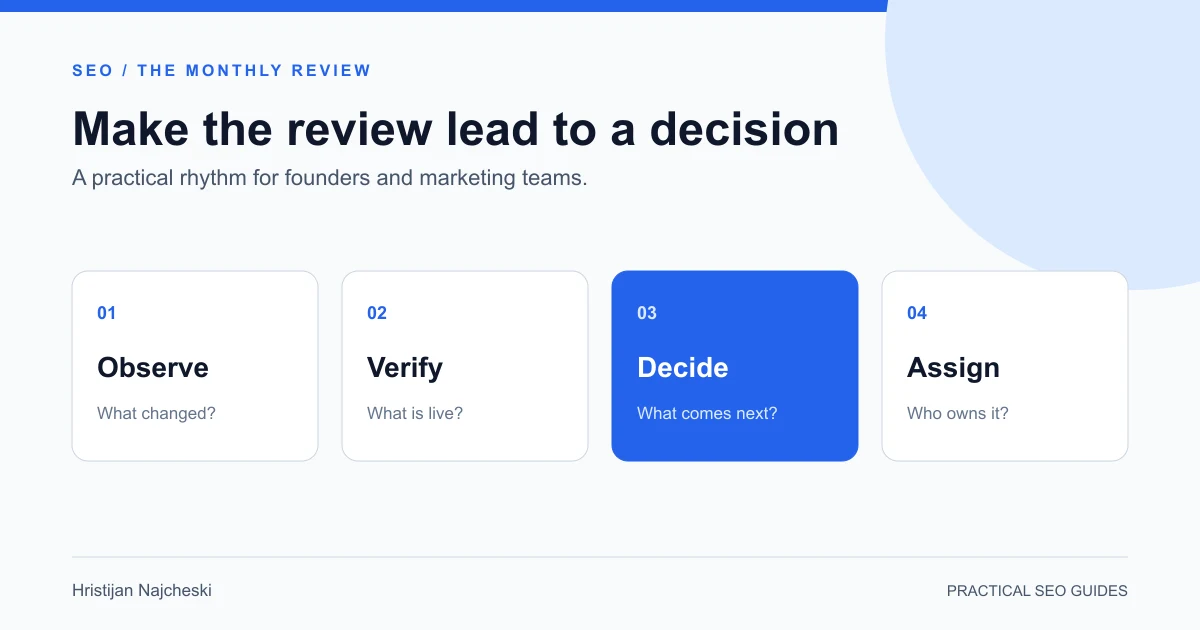
A monthly SEO review should help you decide what to continue, change, investigate or stop. Start with those decisions, then examine the evidence needed to make them. A useful outcome might be approving a page revision, resolving an implementation blocker or leaving a change in place until the next agreed assessment.
For founders and marketing leads, I suggest keeping four records separate: what Search Console shows, what work is complete, what remains uncertain and what the team agrees to do next. Use these distinctions to keep the discussion precise and the commitments clear.
Start with the decision
Before opening a report, write down the business question. Should the team improve an existing service page, investigate a change in its search performance or move its attention to another priority?
Give that question boundaries. Identify the relevant pages, the audience they should serve and the decision you can realistically make during the meeting. Avoid asking the review to settle every open SEO question.
Match the evidence to the decision. For a visibility question, examine search observations. For a commercial investment decision, ask for separate evidence of business outcomes and costs. Keep any revenue conclusion open unless the evidence supports it.
Establish what Search Console shows
Google’s Search Console Performance report provides clicks, impressions, click-through rate and average position for Google Search. It supports comparisons using date ranges, search types and dimensions such as pages and queries. These capabilities and their reporting boundaries are described in Google’s Performance report documentation.
For each comparison, record:
- The periods being compared.
- The search type and filters used.
- The pages or queries relevant to the decision.
- The observed change, without an assumed cause.
Keep the first pass descriptive. State what changed within the chosen comparison. Put the proposed explanation in a separate sentence and label it as a hypothesis.
Use the relevant page or query view to focus the discussion. Avoid walking through every metric when the decision concerns one group of pages. For the broader measurement discussion, see analytics and reporting.
Check implementation separately from performance
Review the previous meeting’s commitments against their owners, deadlines and completion evidence. Ask what is live, what is blocked and what still needs checking.
Distinguish unfinished work, implemented work and work awaiting validation. Record the implementation date as a reference point for later comparisons. Define completion using the agreed task, then assess performance separately.
A sitemap task illustrates the distinction. Confirming submission can close the submission task. Google describes sitemap submission as a hint and does not guarantee that it will download the sitemap or use it to crawl the listed URLs. See Google’s sitemap documentation.
Apply the same discipline to content work. Confirm that the agreed revision is live and meets its acceptance criteria. Then assess its search performance. If implementation is incomplete, identify the blocker and its owner before debating effectiveness.
Challenge the explanation behind the chart
When judging a before-and-after chart, distinguish sequence from cause. The chart may show that a metric moved after an implementation date, but it supplies no direct comparison with what would have happened without the change. Treat that missing comparison as a limit on the conclusion you draw.
Before assigning credit or blame, ask:
- What else changed during the comparison periods?
- Does the observation concern the revised pages or a broader group?
- Which alternative explanations remain unresolved?
- What evidence would strengthen or weaken the working explanation?
A before-and-after chart alone is insufficient grounds for a causal conclusion. Use it to identify questions and assess whether the pattern is consistent with the proposed explanation. Avoid presenting timing as proof.
Use three labels in the discussion: observation, hypothesis and decision. The observation describes the evidence. The hypothesis offers a possible explanation. The decision states what to do with the evidence and uncertainty available.
You can approve a practical next step while keeping its underlying explanation provisional. Record the uncertainty and a condition for reconsidering the choice.
Decide whether to revise, investigate or wait
Before approving another content change, assess the page against its intended reader’s task. What question should it answer? What information is missing? What specific improvement would justify the work?
Google’s people-first content guidance asks whether content serves its intended audience, contributes original value and helps readers achieve their goal. Use those questions as a content assessment aid within their stated scope: Google Search guidance.
Illustrative decision example: A revised service page is live, but the team cannot confidently assess its effect yet. During the review, someone identifies a missing explanation of who the service suits.
Separate the decisions. Assess whether the missing explanation warrants a reader-focused improvement. Keep the performance assessment open until the agreed review point. If nobody can identify a concrete content problem, avoid approving another rewrite merely to show activity.
Choose further investigation when a specific unresolved question could change the decision. Choose waiting when implementation is verified, the rationale still holds and the next assessment has a clear purpose. Give either choice an owner and a review condition. For a wider discussion of page priorities, see content strategy.
An illustrative monthly SEO review agenda
Use this suggested 40-minute agenda as a starting point. Adjust the allocations to the decisions at hand.
- Five minutes — confirm the decision and scope. Agree the business question, relevant pages and comparison periods.
- Ten minutes — examine search observations. Review the evidence relevant to the question and separate it from proposed explanations.
- Five minutes — verify implementation. Confirm completed work, completion evidence and unresolved blockers.
- Ten minutes — examine uncertainty. Challenge the working explanation and identify which unanswered questions matter.
- Ten minutes — agree actions. Choose priorities, owners, deadlines and the evidence needed at the next review.
Assign deeper investigations as actions with a defined question. Keep the meeting focused on decisions the available evidence can support.
Leave with a short decision record
For each action, record the decision, supporting evidence, remaining uncertainty, owner, deadline and condition for reassessment. Include deliberate deferrals so the next review can distinguish a conscious choice from a missed commitment.
Check that each owner understands what completion means. An investigation should name the question it must answer. A revision should name the reader problem it must address. A decision to wait should name when or why it will be reconsidered.
I would prioritise a few decisions with clear ownership over a longer list of loosely defined recommendations. Make the next month’s work specific enough to execute and the next review specific enough to judge.
Further reading: Choose the next task after an SEO audit.