AI search visibility reporting should help answer three business questions: does your brand appear in relevant answers, do people reach your website, and do those visits produce useful outcomes? Measure each separately before choosing a headline metric.
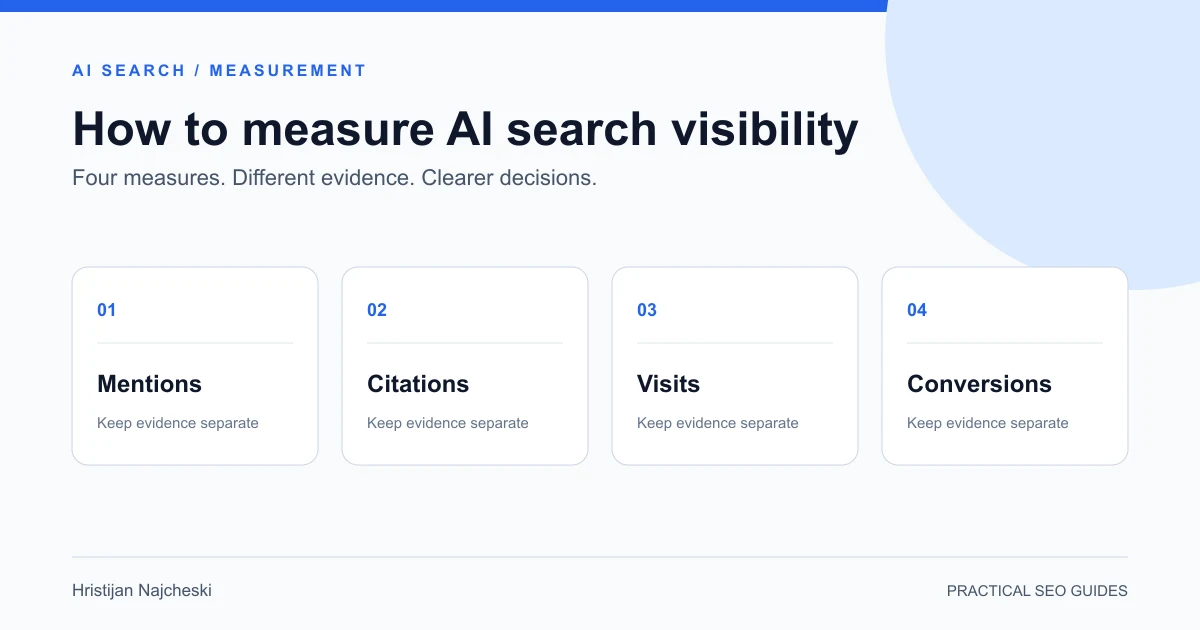
For founders and marketing leads, start with four measures: brand mentions, linked citations, attributed referral visits and recorded conversions. A mention alone is evidence of neither a visit nor a lead.
This guide covers measurement. For background on source selection, see how answer engines choose sources.
Define four measures before collecting data
Use these definitions as reporting conventions and apply them consistently:
| Measure | Counting rule | Evidence to retain |
|---|---|---|
| Brand mention | Your brand appears in the recorded answer, with or without a link. Count each tested answer once. | Saved answer and test details |
| Linked citation | The recorded answer links to your website as a source. Count each tested answer once; list destination URLs separately. | Saved answer, link context and destination URLs |
| Attributed referral visit | Your analytics assigns a visit to a specified referral source under your reporting rule. | Source attribution, date and landing page |
| Recorded conversion | A defined business action meets your stated attribution rule. | Event record and, where relevant, qualification status |
Count mentions and citations independently. An answer can name your brand without linking to it, or cite your website without naming the brand in its text. Record an ordinary website link separately if it does not function as a source citation.
Choose a conversion that matters to the business: a purchase, a booked consultation or a qualified enquiry. If you count form submissions, report qualification separately.
Keep answer observations, platform impressions and website activity in separate fields. Do not add them into one visibility total.
Use Search Console within Google's scope
Google's reporting announcement describes dedicated generative AI performance reports for Search and Discover. It lists impressions and breakdowns by page, country and date, with device reporting available for Search. It also states that this visibility is included in overall performance reporting. Google's generative AI reporting announcement
Use comparable reporting periods and filters when reviewing those figures. Avoid adding dedicated impressions to an overlapping overall total.
The standard Search results Performance report documents clicks, impressions, CTR and average position. Those documented metrics should not be assumed to exist in every dedicated generative AI view. Search results Performance report documentation
Label these figures as Google reporting. Keep Search and Discover clearly identified, and do not treat either as evidence of visibility on other engines. Keep website conversions in a separate outcome view as well.
Build a repeatable manual log for other engines
Start with a small, fixed set of questions relevant to your buyers. Include problem questions, selection criteria and provider comparisons. Separate branded prompts from unbranded prompts so your report distinguishes answers prompted with your name from answers generated without it.
For every test, record:
- The exact prompt and its category.
- The engine and displayed model, or “unknown” when no model is shown.
- The date, time, locale and language.
- Session conditions, including sign-in status and prior conversation.
- The complete response evidence, including visible citations and their destinations.
- Whether the brand appeared and whether your website received a source citation.
- Any failed, incomplete or unavailable response.
Choose a repeat schedule you can maintain, such as weekly. Keep prompts and conditions consistent where possible. Mark changes to the prompt set, model or session setup rather than silently combining different tests.
Report counts with their denominator. “Brand mentioned in 6 of 20 completed unbranded tests” is clearer than an unexplained visibility percentage. Show failed tests separately, alongside the number attempted.
Treat this as a sample of recorded answers. Do not present it as population visibility, buyer demand or market share. Recording conditions helps comparisons, but does not make the sample representative or establish that repeated runs are independent. The log also supplies no evidence of visits or conversions.
Connect visibility evidence to website activity
Build a reporting view with separate columns for manual mentions, manual citations, Google-reported impressions, attributed referral visits and recorded conversions. Give each column its own evidence source and reporting period.
Write down the website attribution rule before interpreting results. For example, you might count conversions completed during visits attributed to a specified referral source. Label that as your reporting convention rather than proof of the buyer's full discovery journey.
Keep unattributed visits in an unknown category. Do not assign them to an AI engine because mentions increased during the same period. Likewise, keep manually observed prompts separate from website sessions unless you have evidence connecting them.
Review landing pages alongside visits and conversions. Use that review to decide whether the destination answers the buying question and offers a relevant next step.
Illustrative example: mentions rise, enquiries stay flat
Suppose 20 completed unbranded tests contain your brand in eight answers this month, compared with four last month. Linked citations remain at two answers. Your analytics records show five attributed referral visits in each period and no qualified enquiries.
The supported conclusion is narrow: mentions increased in the tested sample. Recorded referral visits and qualified enquiries did not increase.
Before commissioning more content, inspect the citation destinations. Assess whether they address the tested questions and make the next step clear. Review the completeness of visit and enquiry tracking before drawing a business conclusion.
Choose one action supported by that review, such as simplifying an unclear enquiry form on a cited page. If conversions later rise, report the change without claiming that the earlier increase in mentions caused it.
Keep readiness separate from observed visibility
Use the AI Brand Visibility Checker for a separate readiness review. Do not interpret a readiness score as evidence that live engine queries ran, your brand appeared in answers or buyers visited your website.
For Google specifically, its guidance says foundational SEO remains relevant to generative AI search, while meeting requirements does not guarantee crawling, indexing or serving. Keep that guidance within Google's scope. Google's generative AI optimization guide
Record readiness issues, proposed fixes and completion status separately. Reserve visibility measures for evidence of actual appearances.
End each review with a decision
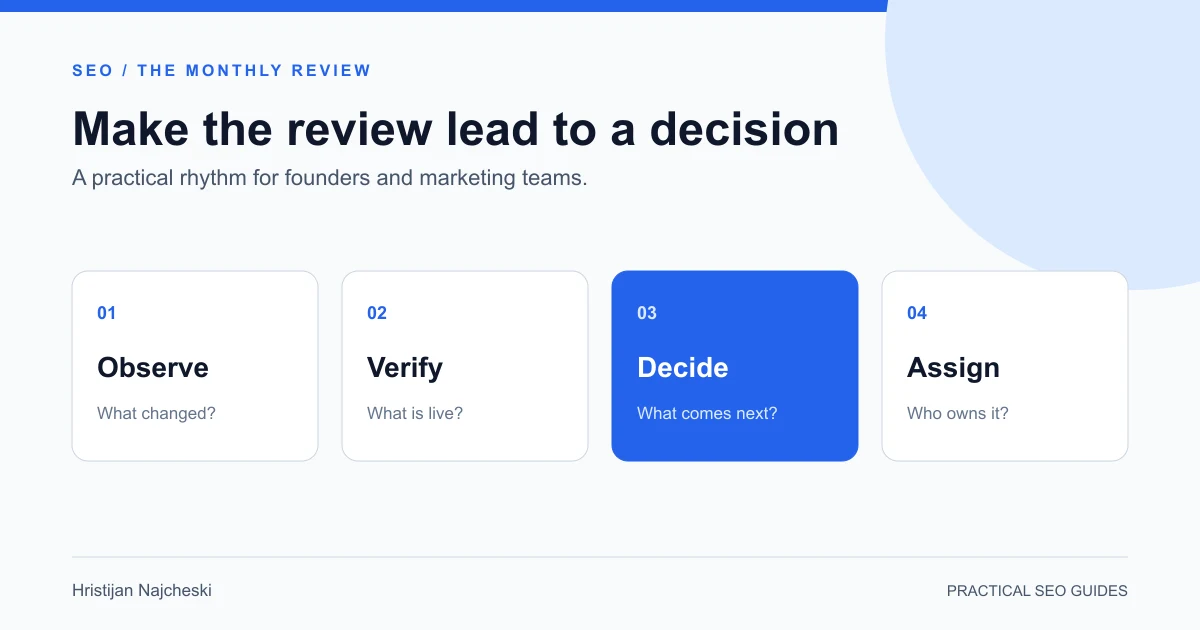
A monthly review should explain what changed, which evidence supports the finding, what remains uncertain and what action follows. Keep the four measures separate throughout, with Google impressions clearly identified alongside them.
Set expectations around measured results without promising rankings, citations or traffic. If attribution and conversion tracking need attention, analytics and reporting support is a relevant next step. Choose the next investment based on the evidence you have and the uncertainty you still need to resolve.
Further reading: Run a monthly SEO review around decisions.