
Getting a page cited in an AI answer involves two separate questions: whether the page is eligible to appear, and whether it actually appears. Keep those questions separate when deciding what to improve and how to measure progress.
For founders and marketing leads, the practical decision is where to spend the next hour or budget allocation. Start with documented requirements, improve the information customers need, and measure the results. Google's guidance provides a basis for Google-specific decisions; it does not establish selection rules for every answer engine.
What happens when Google builds an AI answer?
Google describes grounding responses in pages retrieved from its Search index, using core ranking and quality systems. Query fan-out generates related searches across a question's subtopics. Google's optimisation guide.
That explanation is not a formula for winning a citation. It does not establish that a particular paragraph length, heading pattern or format determines which source appears.
For planning purposes, distinguish the customer's main question from the decisions underneath it. A software comparison might need to address implementation effort, contract terms and reporting limitations. Include those issues because they help someone choose. Evaluate a proposed new page by the distinct need it serves, rather than the number of query variations it targets.
From crawl to citation: eligibility versus selection
Google lists indexing, Search snippet eligibility and inclusion in Search generative AI features in Search Console as requirements. Meeting requirements does not guarantee crawling, indexing or display. Google's eligibility guidance.
Keep an eligibility checklist separate from a visibility record. The checklist asks whether each requirement is satisfied and what evidence supports that conclusion. The visibility record asks where a page appeared, when, and for which observed question or reporting period.
An unresolved access issue belongs on the first list. A citation observed in an answer belongs on the second. A single score labelled “AI-ready” should not replace either record.
This distinction also helps assess proposals. Ask whether the proposed work addresses a documented requirement, improves the page for readers, or tests a visibility hypothesis. Define the intended result before approving the work.
Do schema or llms.txt guarantee citations?
Google says Search ignores llms.txt for visibility and rankings. No special structured data is required for its generative AI features; structured data can support rich-result eligibility. These statements apply to Google Search. Google's markup guidance.
Neither offers a documented guarantee of Google citations. There is also no basis here for promising that either will secure citations from other answer engines.
Before approving an implementation, ask which documented requirement it addresses and how success will be evaluated. A deliverable such as adding a file is easy to describe. The claim that it will cause citations needs its own evidence.
What evidence should guide content decisions?
Google recommends useful, original content. Its guidance specifies neither an ideal page length nor a requirement to divide content into tiny chunks. Google's content guidance.
Use an editorial standard you can inspect: does the page resolve a real decision, support its claims and explain its limitations?
Write down the problem before changing the page. “The comparison omits cancellation conditions” gives an editor something concrete to fix. “The content needs more AI authority” leaves the deliverable unclear.
Treat proposed citation tactics as hypotheses unless supporting evidence establishes more. Keep featured-snippet observations separate from AI visibility measurements. A claimed percentage improvement also needs a source, a defined metric and enough context to assess whether it applies to the decision at hand.
How should you structure a useful answer?
I would start with the reader's decision and work backwards. State the answer, explain the conditions that could change it, and provide enough evidence to assess the recommendation. These are editorial recommendations, not proven citation factors.
Illustrative example: A founder has an existing page comparing monthly and annual software contracts. The page lists prices but omits cancellation terms, onboarding commitments and the cost of unused seats.
The next step is to improve that comparison. Add a table based on verified contract terms, explain when each option makes sense, and identify the assumptions behind any cost calculation. Label fictional calculations as illustrative.
A useful answer might explain that an annual commitment deserves consideration when expected usage is sufficiently clear, while a monthly option deserves consideration when requirements remain uncertain. The actual recommendation should follow the verified terms and the buyer's circumstances.
Consider another article when it answers a materially different need. That gives the work a clear purpose: resolving a missing decision.
What can an AEO readiness audit measure?
Use the AEO readiness audit as a starting point for reviewing a page. Assess each finding according to its evidence rather than treating the overall grade as a citation probability.
Separate three kinds of evidence:
- Page observations: what the assessment detected in the inspected content.
- Eligibility evidence: whether relevant requirements have been checked and satisfied.
- Results: observed visibility and associated business activity.
A detected heading or schema item belongs in the first category. Its presence does not establish how an engine weights it. A page inspection alone cannot confirm indexing or explain why an engine selected a particular source.
For each finding, ask what was inspected, what conclusion follows and what remains unknown. Record unavailable evidence as unknown rather than converting it into a pass or failure.
Use the technical SEO checklist to organise implementation planning. Tie each proposed fix to a specific problem, an owner and a way to confirm completion.
How do you measure visibility and results?
Google's announcement documents dedicated generative AI performance reports for Search and Discover, with worldwide rollout completed by August 31, 2026. It lists impressions, pages, countries and dates, plus devices for Search. This visibility data also remains in overall performance reporting. Google's reporting announcement.
The overall Search results Performance report provides clicks, impressions, CTR and average position. Its documentation does not establish that all those metrics are available in the dedicated AI reports. Search Console Performance documentation.
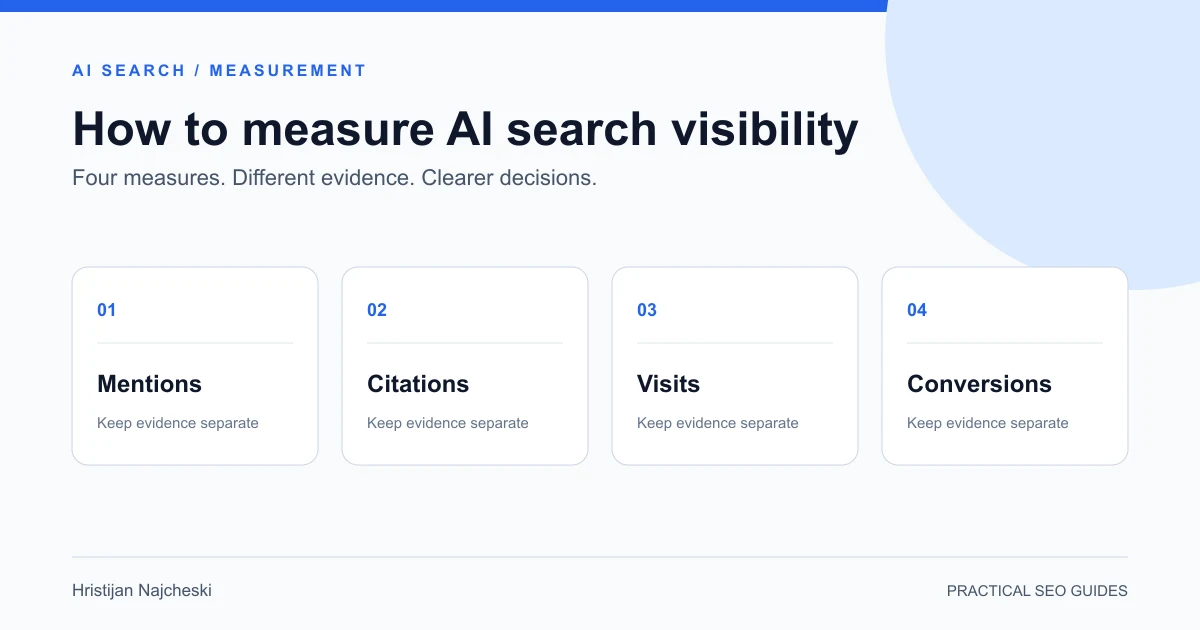
Build a measurement plan around separate questions: where did the page appear, did people visit, and did those visits support a business goal? Keep each metric attached to the report and scope it actually describes.
For manual answer sampling, record the engine, question, date, cited URL and relevant context. Describe the result as an observation from that sample. Avoid treating one answer as a stable position or falling CTR alone as proof that AI answers caused the change.
What should founders and marketing leads do next?
Choose a small set of commercially relevant pages. Resolve evidenced eligibility problems, improve missing decision information and establish a reporting baseline before assessing results.
A page-level review suits a focused content question. When the problem spans multiple pages or competing priorities, consider a broader SEO audit.
Judge proposed work by the problem it addresses, the evidence behind it and the result you can observe. Do not accept guarantees of rankings, citations or traffic based on a file, schema implementation or readiness grade.
Further reading: How to measure AI search visibility.