Link building has changed more in the last two years than in the previous ten. AI-generated content has flooded the web, Google has tightened its quality signals, and the old playbook of "publish a blog, do guest posts, buy a few links" is delivering diminishing returns. I want to walk you through the seven link building strategies I'm actually using with clients in 2026 — what's working, what I've stopped doing, and where the real opportunities are.
Why I'm Writing This
I work with growing businesses who often arrive having tried link building once or twice — usually with an agency that promised "high-DR backlinks" and delivered private blog network spam, or a freelancer who sent 200 cold outreach emails and got two "yes, $500 per link" replies. Both outcomes leave them sceptical that link building works at all.
It does work. But the strategies that work in 2026 require more thought, more creativity, and more patience than the tactics that worked in 2018. Here's my actual playbook.
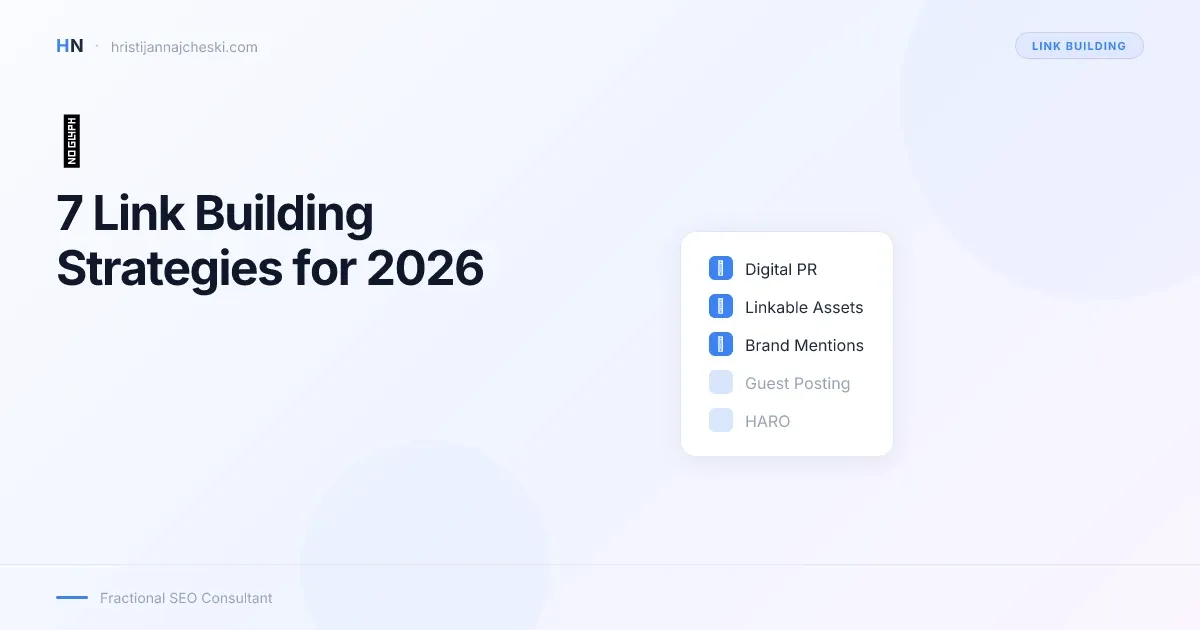
1. Digital PR With a Genuine Hook
This is the single highest-leverage strategy I use today. The idea is simple: produce something newsworthy — original research, a survey, a tool, or a strong opinion piece — and pitch it to journalists who cover your niche.
What "genuine hook" actually means:
- Original data nobody else has (a survey of your customers, an analysis of public datasets, a benchmark study)
- A counterintuitive finding that journalists can build a story around
- Tied to a current trend or news cycle so the pitch has a "why now" reason
I had a client in the e-commerce space who surveyed 500 of their customers about a specific buying behaviour. We turned the results into a 2,000-word report with charts and pitched it to trade press. Twelve articles linked back over six weeks — including two from publications with seven-figure monthly traffic. That's a year's worth of cold outreach in one campaign.
2. The "Linkable Asset" Approach
Most blog content doesn't earn links. Specific types of content do. I focus my clients' content investment on what I call linkable assets:
- Statistics roundups — pages that aggregate stats on a topic become reference material that other writers cite
- Original research — surveys, data studies, benchmarks (overlap with digital PR)
- Free tools — calculators, generators, templates. These are evergreen link magnets. I built a SERP snippet previewer for exactly this reason.
- Definitive guides — the kind of comprehensive resource people link to as "the best resource on X"
If you're investing in content, ask one question before each piece: would another website link to this? If the honest answer is no, it's a content piece for your audience but not a link magnet. Both have a place — just don't confuse them.
Want help building linkable assets that actually earn coverage?
Book a Free Strategy Call →3. Unlinked Brand Mentions
This is the lowest-hanging fruit nobody picks. People are already talking about you online — they just haven't linked. A simple monthly process:
- Set up a Google Alert (or use Ahrefs / Mention) for your brand name
- Monthly, scan for mentions without links to your site
- Reach out politely to the author and ask for a link
Conversion rates on this are 30–50% because the relationship is already there. They mentioned you. You're just asking for the link they probably meant to add. I rarely see clients running this consistently — and the ones who do typically pick up 5–15 free links a year.
4. Strategic Guest Posting (Yes, Still)
Guest posting got a bad reputation because it was abused. Done properly, it still works in 2026 — but the bar is much higher. My rules:
- Quality over quantity. One guest post on a genuinely authoritative site beats 20 on link farms.
- Relevance matters more than DR. A link from a niche-relevant site with 50 referring domains often outranks a generic high-DR link.
- Original, valuable content. If you wouldn't post it on your own site, it's not good enough for someone else's.
- Natural anchor text. Exact-match anchors are a flag now. Branded or natural-language anchors are safer and just as effective.
5. HARO and Expert Source Platforms
HARO has been replaced/supplemented by tools like Qwoted, SourceBottle, and Connectively. The premise is the same: journalists request expert quotes; you respond; if they use your quote, you typically get a link.
It works if you commit to it. I tell clients: 30 minutes a day, three days a week, for three months. After that, you'll know if it's a fit for your niche. Some industries (B2B, finance, marketing, tech) have strong daily query flow. Others (very niche B2B verticals) get fewer relevant requests but higher conversion when they do appear.
6. Broken Link Building (When It Fits)
The classic tactic: find broken links on relevant resource pages, suggest your content as a replacement. It still works, but it's labour-intensive and the ROI varies hugely by niche.
I use it selectively — usually as a "fill-in" tactic when a client has a great piece of content that maps perfectly to a category of resource pages (industry directories, "best of" roundups, link lists from universities or non-profits). If I'm spending three hours finding one opportunity, it's not worth it. If I can identify 20 in an afternoon, it absolutely is.
7. Internal Linking — The Forgotten Lever
I include this in every link building list I make, because most people don't realise that internal linking is the cheapest, highest-leverage form of link building you have access to. Every piece of content you publish is a chance to pass link equity to important pages.
What I do for clients:
- Identify "money pages" (services, key product pages, top blog posts)
- Audit how many internal links each receives
- Add contextual links from related, high-authority pages on the site
- Restructure navigation and footer linking to flow equity strategically
I've seen pages move from page 2 to page 1 with nothing more than 30 well-placed internal links. It's not glamorous, but it's reliable.
What I've Stopped Doing
- PBN links. Private blog networks are easier to detect than ever. Not worth the risk.
- Link exchanges with random sites. Three-way "link triangles" are still tracked and discounted.
- Cheap mass outreach. 500 emails sent through a sequencer with a generic template might get one link — and it's usually a bad one.
- Forum and comment spam. Hopefully obvious, but I still see "SEO services" companies offering this.
- Buying links from "guest post brokers." Most of their inventory is monitored. Google has gotten very good at spotting paid placements.
How to Prioritise If You're Just Starting
If you have to pick where to start, my order is:
- Internal linking audit — free, takes a few hours, immediate impact
- Unlinked brand mentions — easy wins, builds momentum
- One linkable asset — invest in producing one really strong piece you can pitch
- Digital PR campaign around that asset — convert the asset into coverage
- HARO + expert source work — drip-feed authority over time
That sequence builds momentum without burning the entire budget on tactics that may or may not fit your niche.
Closing Thought
The most underrated truth about link building in 2026 is this: the businesses ranking well aren't doing more outreach than their competitors — they're producing better content and pitching it more thoughtfully. The link building strategy that compounds is the one that's tied to genuinely useful work. Everything else is noise.
If you'd like me to look at your link profile and recommend where to start, I run dedicated link-building engagements as part of my fractional SEO work.